


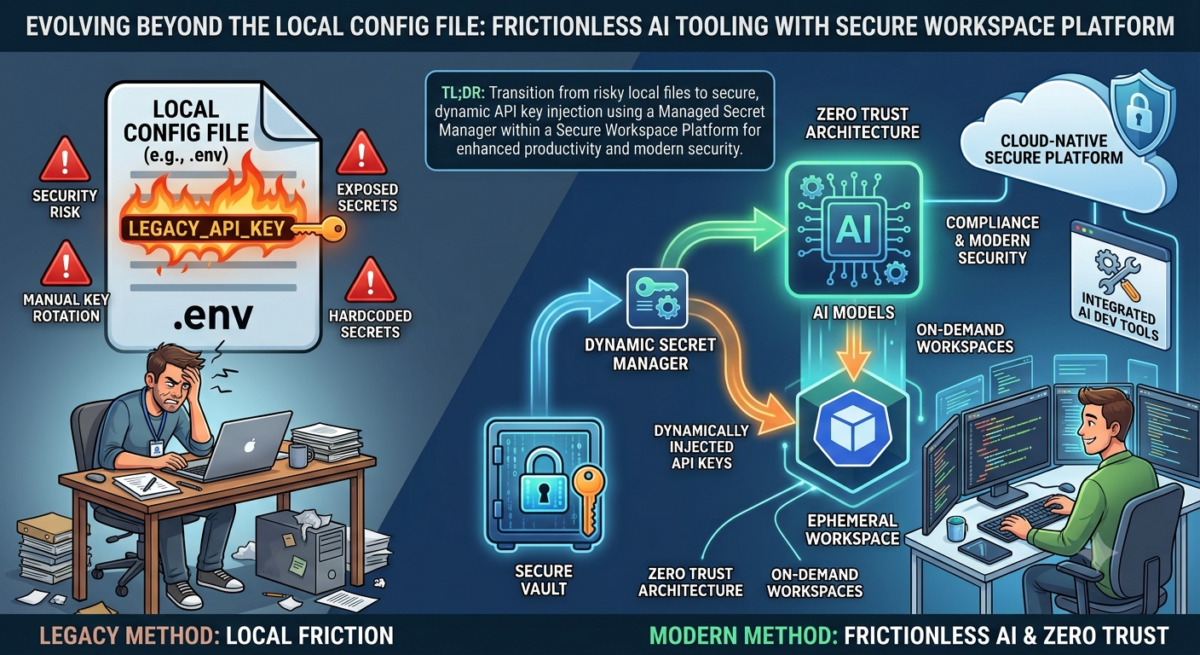
TL;DR: AI-assisted coding tools are transforming developer productivity. However, managing access to these tools via local .env files introduces significant security risks and operational friction. This article explores how to achieve a Zero Trust architecture using the Red Hat Advanced Developer Suite, OpenShift Dev Spaces, and the External Secrets Operator to dynamically inject AI API keys directly into ephemeral workspaces.
The DevEx Bottleneck: Decentralized Secret Management
Consider the current workflow required to equip a developer with an AI coding assistant. Typically, a developer waits on an IT ticket for an enterprise API key from an LLM provider. Once received, they must manually copy and paste that highly privileged token into a local .env file or export it within their local terminal profile.
From both a Developer Experience (DevEx) and Zero Trust perspective, this decentralized approach creates multiple bottlenecks:
- Onboarding Friction: Day-one productivity is delayed by manual configuration steps and troubleshooting local credential paths across different operating systems.
- Flow State Disruption: Developers face the constant risk of accidentally committing a .env file to a public Git repository, forcing them to double-check configurations rather than writing code.
- Operational Interruptions: Mandatory key rotations trigger a team-wide operational event where developers must pause work and manually update local machines.
The Architecture Shift: Zero Trust with Advanced Developer Suite
To build high-velocity teams, we need to achieve “DevEx as Security”—giving developers a cutting-edge toolchain without requiring them to handle the underlying credentials.
Organizations can accomplish this by abandoning fragile local configurations and embracing the Red Hat Advanced Developer Suite (ADS). ADS provides standardized, containerized cloud environments via Red Hat OpenShift Dev Spaces, which are strictly defined by a standard devfile.yaml and run consistently across the hybrid cloud.
By pairing this environment with the External Secrets Operator (ESO) for Red Hat OpenShift, you can establish an invisible, inherently secure pipeline:
- The Central Secret Vault: Master AI API keys are stored securely in an enterprise-grade central source of truth, such as CyberArk Conjur, HashiCorp Vault, or major Cloud Service Provider secret managers.
- The Secure Bridge: A ClusterSecretStore Custom Resource (CR) is deployed within Red Hat OpenShift, acting as an authenticated bridge to automatically verify access to the central vault.
- Dynamic Injection: When a developer spins up their Dev Spaces environment, ESO detects active keys using an ExternalSecret CR, and securely injects them directly into the runtime as environment variables.
When the developer opens their terminal, they simply invoke their AI tool of choice. The AI API key is already present in the background, with absolutely zero local persistence.
Accelerating Modernization with Developer Lightspeed
Once the workspace is secured, organizations can safely deploy enterprise-grade AI capabilities directly into the workflow. A prime example is Red Hat Developer Lightspeed for the Migration Toolkit for Applications (MTA), included with the Red Hat Advanced Developer Suite.
MTA uses a rule-based analysis engine to evaluate legacy code for modernization opportunities. With the Developer Lightspeed add-on within their IDE, developers receive intelligently generated code solutions and can automatically apply fixes with a single click. Because the environment is centrally governed by ADS, teams can leverage generative AI—using a preferred public or self-hosted LLM—without risking the exposure of proprietary code or leaking manual API keys.
Conclusion: Instant Onboarding and Unblocked Velocity
By standardizing on OpenShift Dev Spaces and abstracting credentials via the External Secrets Operator, engineering teams realize immediate benefits:
- Frictionless Team Mobilization: Project leads can provision a fully configured, AI-ready environment with a single click. Offboarding is equally seamless; revoking access spins down the workspace, ensuring no credentials remain on local hardware.
- Unblocked Velocity: Removing the administrative burden of credential management keeps developers in their flow state so they can ship software faster.
- Collaborative Security: Security teams shrink the permissions scope and blast radius of potential breaches by centralizing keys, while engineering gets frictionless access.
Red Hat Developer Lightspeed for migration toolkit for applications: This official video from Red Hat Developers showcases how the MTA Developer Lightspeed add-on provides AI-generated code solutions directly within the IDE, aligning perfectly with the frictionless AI workflow described in the blog.